

Why Handmade Kashmiri Products Are Better Than Machine-Made
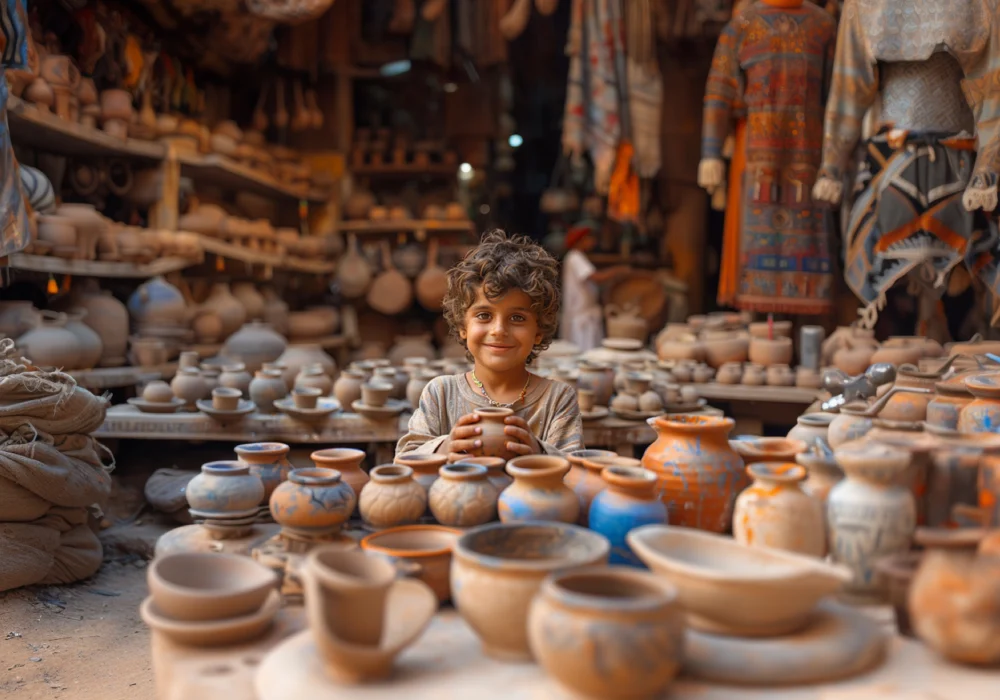
There is a moment, right when you unfold a handmade Kashmiri shawl for the first time, when you feel something that is very hard to put into words. It is warm. It is soft. But more than that — it feels alive. That feeling comes from the fact that another human being spent weeks of their life making it just for you. No machine in the world can replicate that feeling.
Today, the world is flooded with machine-made products. Walk into any store, open any website, and you will find thousands of items that look similar, priced cheaply, and produced in seconds. But if you look a little closer, you will notice they all share one thing — they feel empty. There is no story behind them, no person behind them, and no love behind them.
Authentic Kashmiri handicrafts are the exact opposite of that. And in this blog, we are going to walk you through exactly why — in a way that is easy to understand, real, and something you can actually feel when you make your next purchase.
600+ Years of Kashmiri Craftsmanship: A Living Heritage
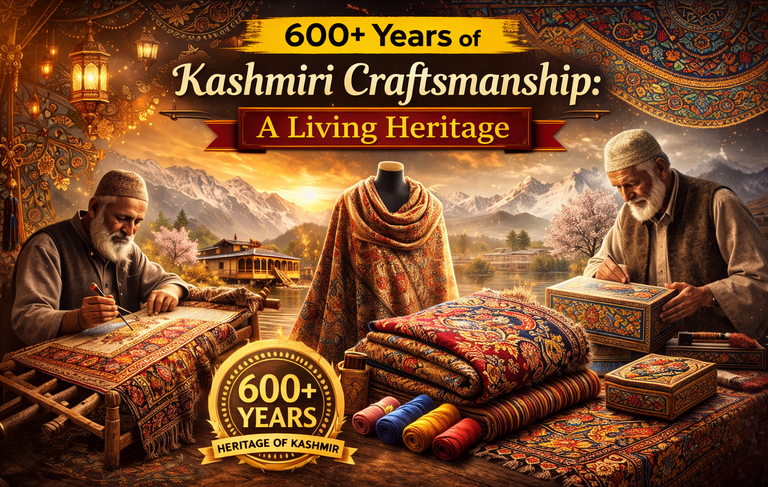
To understand why Kashmiri handicrafts are so exceptional today, you have to go back to where they started. The craft tradition of the Kashmir Valley is not something that developed overnight. It was carefully built, refined, and passed down over more than six centuries — beginning with the Sultanate period in the 14th century and reaching its peak under the great Mughal emperors who made Kashmir their summer retreat.
Emperor Akbar was so moved by the quality of Kashmiri Pashmina that he made it a royal fabric, reserved for the court. The delicate shawls, the intricate woodwork, the hand-knotted carpets — all of these were considered luxury goods of the highest order, traded along the Silk Route to Persia, Central Asia, and eventually Europe. The British colonial era further spread the fame of Kashmiri shawls across the Western world, where they became the most coveted fashion item of the 19th century.
The Pashmina shawl was once gifted between royal courts as a symbol of respect and power.
Why Machines Can Never Replicate Authentic Kashmiri Art
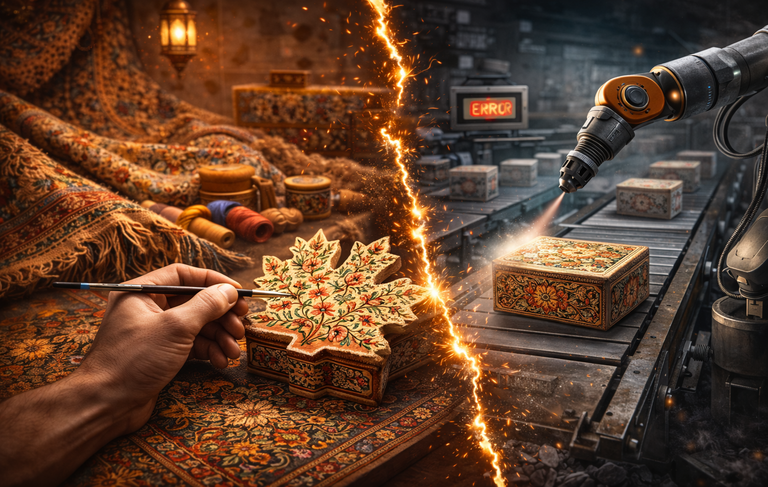
Kashida embroidery is one of the most complex and beautiful art forms in the entire world. Artisans spend between three weeks to six months completing a single piece, depending on the complexity of the design. The patterns — which are deeply inspired by the flowers, trees, birds, and rivers of the Kashmir Valley — require a level of decision-making with every stitch that no algorithm can replicate.
When you look closely at a piece of hand-embroidered Kashmiri fabric, you can actually see the path of the needle. The slight variation in each petal, the way the color depth changes across a single flower, the way the thread catches light at different angles — all of this comes from a living, breathing, thinking human being making thousands of tiny creative decisions in real time.
“Handmade is not just a method. It is a language that speaks directly from one human being to another, across time and distance.”
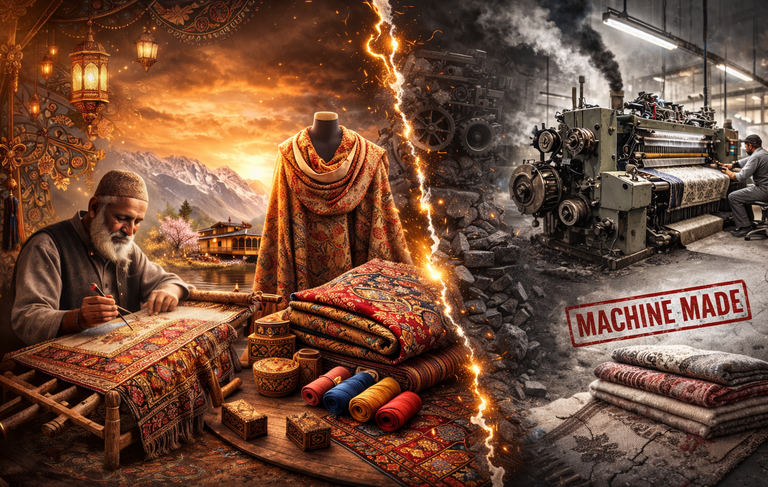
A machine can print a pattern that looks similar from a distance. But put it next to a hand-embroidered piece and the difference is immediate and obvious. The machine print is flat, uniform, and lifeless. The sozni embroidery piece has depth, texture, and a living quality that draws your eyes in closer every time you look at it.
Handmade vs Machine Made — The Real Comparison
| Factor | Handmade Kashmiri | Machine-Made |
| Quality | ✓ Superior | ✕ Average |
| Durability | ✓ Decades+ | ✕ 1–3 Years |
| Uniqueness | ✓ One of a Kind | ✕ Mass Identical |
| Eco Impact | ✓ Minimal | ✕ High Footprint |
| Artisan Support | ✓ Direct | ✕ None |
| Feel & Texture | ✓ Luxurious | ✕ Synthetic |
| Resale Value | ✓ Appreciates | ✕ Depreciates |
Why Handmade Kashmiri Products Last Longer Than Mass-Produced Alternatives
This is one of the most overlooked reasons to choose handmade, and it is also one of the most practical. When you buy a handcrafted Kashmiri product, you are not buying something that will last a season. You are making an investment in something that will last years — and in many cases, decades or even a lifetime.
Consider hand-carved walnut wood crafts from Kashmir. A skilled carver selects the wood carefully, works with the natural grain, and creates joints and finishes that align with the material’s natural properties. The result is a product that handles daily use, moisture, and temperature changes without breaking down.
Machine-made products, on the other hand, are often built for a specific price point. Materials are chosen based on cost, not quality. Construction is fast, not careful. The result is something that might look good when you first buy it, but starts showing weakness within a few months.
When your grandmother passes down a hand-woven shawl or a carved wooden box to you, that is not just an emotional moment — it is proof that the product was built well enough to last generations. That is what durable Kashmiri handicrafts are designed to do.
How to Care Kashmiri Handicrafts and Make Them Last a Lifetime
Owning a genuine Kashmiri handicraft comes with the wonderful responsibility of caring for something truly special. The good news is that proper care is simple — and when done right, your handmade piece will only get more beautiful over time. Here are the essential care tips:
- Pashmina and wool shawls: Hand wash in cold water using a gentle, pH-neutral soap. Never wring or twist. Lay flat on a clean towel to air dry away from direct sunlight. Do not use a machine dryer.
- Storage: Store shawls and textiles folded (never hung, as hanging causes stretching) in a breathable cotton bag. Add a few dried lavender sachets to protect against moths without chemicals.
- Walnut wood items: Wipe with a slightly damp cloth and dry immediately. Apply a thin coat of natural wood oil every six months to keep the grain nourished and prevent cracking.
- Papier-mâché pieces: Keep away from moisture and direct sunlight. Dust gently with a dry soft cloth. Avoid placing in humid environments.
- Embroidered fabrics: If ironing is needed, always iron on reverse side at low heat, or place a thin cotton cloth between the iron and the embroidery to protect the thread.
- Carpets and rugs: Rotate your hand-knotted Kashmiri carpet every six months for even wear. Vacuum gently from the back side. Professional cleaning once every two years is recommended.
Taking care of a handcrafted Kashmiri product is not complicated — it just requires a little more attention than a machine-made item. But the reward is a product that lasts decades and grows more precious with every passing year.
A Simple Buyer Checklist — How to Spot Fake Kashmiri Products
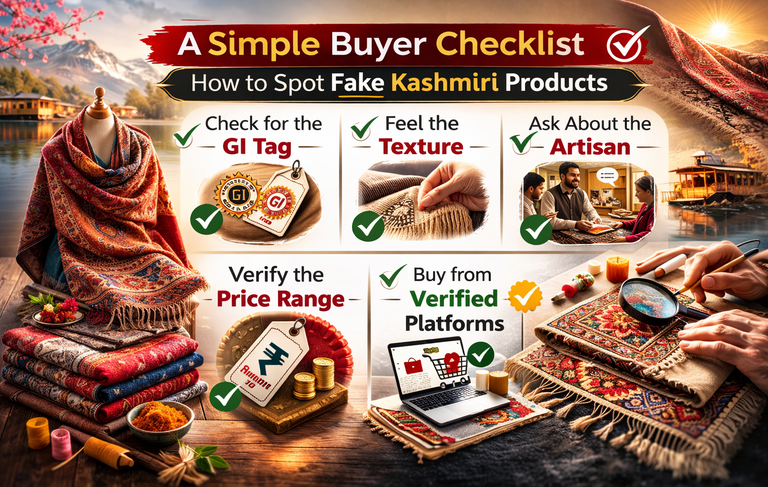
With the popularity of authentic Kashmiri handicrafts has come a wave of imitations. Products are being mass-produced in other regions and falsely labeled as Kashmiri. Knowing what to look for protects your investment and ensures your money reaches real artisans. Use this checklist every time you buy:
- Check for the GI Tag: Genuine Kashmiri products carry a Geographical Indication (GI) certification tag. This is a government-issued authentication — if it is absent, ask why.
- Feel the texture: Real Pashmina is incredibly soft and warm. Run it through a ring — genuine Pashmina passes through smoothly. A synthetic blend will bunch up or resist.
- Look at the edges and borders: Machine-made products have perfectly uniform borders. Handmade pieces have slight natural variations — not flaws, but proof of human hands.
- Check the reverse side of embroidery: On genuine hand-embroidered fabric, the reverse side shows the actual path of the needle — it looks worked and deliberate. Machine embroidery has a flat, clean back with no variation.
- Ask about the artisan: A trusted seller like Kashmir Mart can tell you exactly where and by whom each product was made. If a seller cannot answer that question, be cautious.
- Verify the price range: Authentic handmade Kashmiri products require significant time and skill to create. A Pashmina shawl priced suspiciously low is almost certainly not genuine.
- Look for natural dye variation: Handmade products dyed with natural plant dyes show slight, beautiful variation in color depth. Machine-dyed products are perfectly uniform — which actually signals they are not handmade.
- Buy from verified platforms: Platforms like Kashmir Mart work directly with verified artisans and provide complete product authenticity. Always prefer a trusted source over an unknown marketplace listing.
Armed with this checklist, you can shop with complete confidence. The more you know, the better you can protect yourself — and the more you support the real artisans whose livelihoods depend on buyers choosing genuine over fake.
Every Kashmiri Handmade Purchase Is a Choice for the Environment
We talk a lot about sustainability today, but most people do not connect buying sustainable Kashmiri products to living an eco-conscious life. They should. Handmade crafts from Kashmir are among the most environmentally responsible products you can buy anywhere in the world.
Here is the simple truth: an artisan in a small workshop uses natural materials, traditional tools, and manual energy. Their production process leaves almost no carbon footprint. Compare that to a factory running heavy machinery 24 hours a day, consuming massive amounts of electricity, using chemical dyes in large quantities, and generating industrial waste.
The raw materials used in organic Kashmiri crafts — Pashmina wool, walnut wood, natural plant dyes, papier-mâché made from recycled materials — are all either biodegradable or naturally sourced. Choosing these products is not just good for you. It is genuinely good for the planet.
You Own Something No One Else in the World Has .
There is a very specific kind of joy that comes from owning something truly unique. Not just rare — truly one of a kind. When you buy an exclusive Kashmiri handmade item, that is exactly what you are getting. Because every piece is made by hand, no two pieces are ever perfectly identical.
The slight variation in the weave pattern, the specific way the embroidery petals curve, the unique color depth in a hand-painted Kashmiri box — these are not flaws. They are fingerprints. They are proof that a real human being made this specifically, and that no copy exists anywhere in the world.
Machine-made products are designed to be identical. That is their whole point — consistency at scale. But when everything is identical, nothing is special. When you wear a handmade shawl from Kashmir, you are wearing something that is yours and only yours. That is a kind of value that no price tag can fully capture.
Your Purchase Directly Supports a Real Family
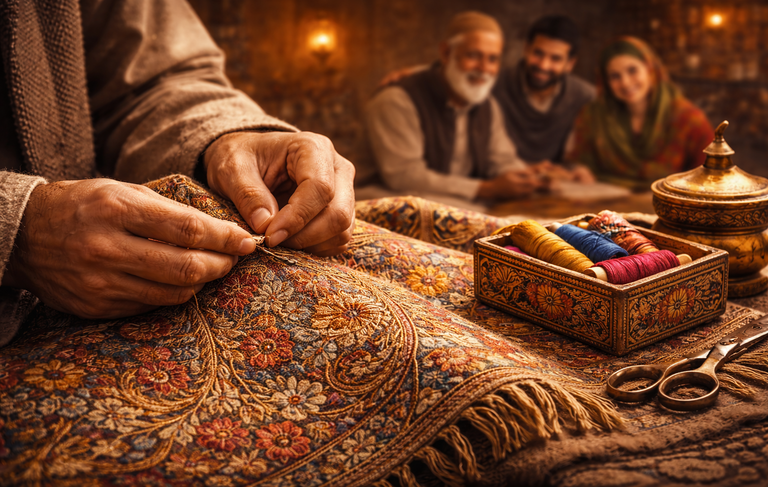
This is the part that most people do not fully think about, but once you do, it changes the way you shop. When you buy a machine-made product from a large factory brand, the money you spend goes through layers of middlemen, logistics companies, and corporate margins before a tiny fraction reaches anyone who actually worked on it.
When you buy from a platform like Kashmir Mart that works directly with local Kashmiri artisans, the impact is immediate and direct. The money reaches the craftsman. It helps them buy better materials for their next piece. It helps them send their children to school. It helps them keep their workshop open for another season.
Most of these artisans are not wealthy. They are skilled, dedicated, and deeply proud of their work. They have chosen to spend their lives preserving an art form that is thousands of years old. Every time you choose handmade, you are choosing to support that decision. You are voting with your money for a world where skill is valued, where tradition survives, and where real people can build a dignified living doing what they love.
“When you buy handmade, you are not just buying a product. You are keeping a tradition alive.”
The Final Word — Choose Real, Choose Handmade, Choose Kashmir
That is the full case for handmade Kashmiri products. It is a case built on quality, heritage, sustainability, uniqueness, the joy of gifting, and the simple truth that when something is made by human hands with real skill and real care, the result is always better. Not marginally better. Profoundly better.
At Kashmir Mart, every product in our collection is sourced directly from verified artisans across the Kashmir Valley. We do not work with factories. We do not sell imitations. We carry only what is real — because that is the only thing worth carrying.
“Buy less. Buy better. Buy handmade from Kashmir.”
Ready to Own Something Real?
Explore our full collection of 100% authentic handmade Kashmiri products.
Every piece is sourced directly from skilled artisans in the Kashmir Valley.
Visit: kashmirmart.com