

Exporting Kashmiri Handicrafts: Process & Documentation Guide
Table of Contents
ToggleA Common Story Every Kashmiri Seller Knows Too Well

Imagine you have a buyer located in Germany ready to buy 50 of your Pashmina shawls. You are thrilled, until you start to wonder if you can even export products, what documentation will be required to import/export–enable your products, and whether you have a Geographical Indication tag on your GIs. That single order, turns into something you can’t even figure out how to get out to the rest of the world, even though you are confident about the quality of your product. Questions like
“Can I even export?” “What documents do I need?” “Do I have a GI Tag for my products?”
That one incredible order — the one you have been waiting for — suddenly feels overwhelming. You know your product is world-class. But getting it into the world? That part is a mystery.
You are not alone. Thousands of artisans and sellers across Kashmir face this exact moment every day — a brilliant craft, a willing buyer, and no clear path forward.
Regardless of whether you are weaver of Pashmina shawls in Srinagar, a maker of walnut wood furniture in Sopore, or running a Papermache shop that has been a family craft for generations; this document will provide you with a roadmap to follow to successfully export your handicrafts Globally.
Why Exporting Kashmiri Handicrafts Is Your Biggest Business Opportunity Right Now
The rise in popularity of “handmade, authentic, and culturally” has created an opportunity to build an interconnected global marketplace for handmade products — particularly in relation to Kashmiri handicrafts. Some of the reasons that now is the right time to take advantage of this opportunity include:
• According to market research, worldwide sales of handmade luxury items are expected to rise to $1.2 trillion by 2027; and consumers increasingly desire products that originate from an authentic cultural source.
• Since the COVID-19 pandemic, consumers across a number of countries — including the US, UK, Germany, the UAE and Japan — are switching from buying mass-produced goods to buying unique and artisanal items.
• In India, the total value of exports of handicrafts exceeded ₹33,000 crores in 2022-23, and the amount attributable to Kashmiri handicrafts continues to grow year over year.
• Today, e-commerce platforms (e.g., Amazon Global, Etsy, Novarese) make it easier than ever to connect directly to international consumers.
Why Kashmiri Handicrafts Are in High Demand Globally
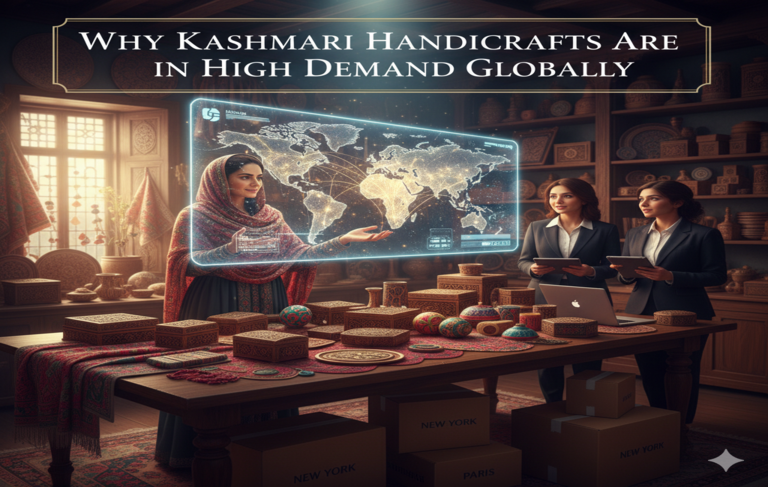
Every handcrafted item across different countries isn‘t necessarily held to the same degree of international esteem. As far as Kashmiri artisans are concerned, they possess something unique; these products embody a rich cultural history that has been preserved for generations, represent quality workmanship that cannot be replicated anywhere else on the planet, and they also benefit from protective designation as a Geographical Indicative (GI) therefore separating them legally from all imitations globally.
Below is a quick synopsis of some of the most significant product categories generating a high level of international demand from buyers:
Product | Key Export Markets |
Pashmina Shawls & Stoles | USA, UK, France, Germany, Japan, UAE |
Kashmir Carpets (Hand-Knotted) | USA, Germany, Italy, Saudi Arabia, Canada |
Walnut Wood Carving | Europe, USA, Gulf Countries |
Papier-Mache Products | USA, UK, Australia, Germany |
Sozni & Aari Embroidery | USA, UAE, UK, Singapore |
Copper & Silverware (Khatamband) | Middle East, Europe, USA |
Crewel & Chain Stitch Fabrics | Interior designers in UK, USA, France |
How a GI Tag Protects and Promotes Your Kashmiri Craft Globally
If you are in the business of exporting handicrafts from Kashmir then your most valuable asset is the Geographical Indication (GI) tag. Many exporters do not know about or how to take advantage of the GI tag.
What is a GI Tag?
A GI Tag is a legal document that certifies that the product comes from a specific geographical region and has specific qualities or a reputation based on that location. When it comes to handicrafts from Kashmir, buyers all over the world and customs will have the ability to trace and verify that these products are made in Kashmir.
Examples of Handicrafts with GI Sponsorship
• Kashmir Pashmina
• Kashmir Hand-Knotted Carpet
• Kashmir Machine–Made Paper
• Kashmir Walnut Wood Crafts
How the GI Tag Helps You Export
• Allows for the legal marketing of your product as an authentic Kashmiri product in the international marketplace.
• Protects against lower–priced imitations from China and others in the international marketplace.
• Increases the confidence of the buyer as to the authenticity of the product and works especially well with buyers in premium markets like the European Union, United States, and Japan.
• Gives access to government programs that promote exports that have GI status.
For assistance with registering or verifying your GI status please contact the Craft Development Institute (CDI) in Srinagar or a representative from your national government.
What You Need to Know Before Exporting Kashmiri Handicrafts
To ship your initial export consignment, there are some basic requirements you must meet first:
1. Register Your Business
with a legal business entity registered in India (i.e. Proprietorship, Partnership, LLP or Private Limited Company). This is a requirement for exporting since your business is not recognised by the Indian Government unless you register.
2. Get an IEC (Import Export Code)
The IEC is a ten (10) digit code issued by the Directorate General of Foreign Trade (DGFT). Without an IEC, you will not legally be able to export your goods from India. The good news is that you can obtain your IEC online at dgft.gov.in within 2 to 3 working days.
3. Open a Current Bank Account
You will need to open a current account with a scheduled commercial bank in order to receive international payments and access export benefits.
4. Understand FEMA Regulations
The Reserve Bank of India (RBI) mandates that all export payments be made through proper banking channels according to the Foreign Exchange Management Act (FEMA). Notify your buyer that the payment must be sent over wire transfer (SWIFT), PayPal Business or by Letter of Credit.
5. Know Your HS Code
Each export item has a Harmonized System (HS) code used to determine the amount of duty payable or tax charges on the product. (For example, HS617/6214 for Pashmina and HS5701 for hand-knotted carpets). If you incorrectly classify your items, this will delay the clearance of your consignment from India and will lead to penalties imposed on you.
How to Start Exporting Handicrafts from Kashmir: A Step-by-Step Process
Following a structured process will save you time, money, and a great deal of stress. Here is how to move from zero to your first international shipment.
Step 1 — Register Your Business & Get IEC
This is your legal entry ticket to export. To register your business, you will need to obtain an Import Export Code (IEC) from the DGFT portal. You will pay ₹500 for this process.
Step 2 — Identify Your Target Market & Buyer
You need to know who is going to be a potential buyer of your product as well as their location before you start packing any boxes.
Step 3 — Get Your Product Tested & Certified
You need to have your product tested and certified by an independent laboratory, which will enhance buyer confidence in your product and provide access to other premium markets including the EU and the USA.
Step 4 — Prepare Your Export Quotation & Proforma Invoice
The first point of contact you will have with your buyer is this export quotation. This document will also be the basis for every other document that is generated through the course of processing your export transaction.
Step 5 — Arrange Packaging
Packaging is the first thing a buyer will touch — so make sure that the packaging that you use is export ready, compliant with labelling requirements, and worthy of the product inside.
Step 6 — Choose Your Logistics Partner
Your choice of CHA or freight forwarder will allow you to focus on your craft rather than on completing the customs paperwork necessary for exporting your product.
Step 7 — Create Shipping & Export Documents
You will need to ensure that each document you create is correct in its content. A single document that is missing will result in being held at the border forever.
Step 8 — File Shipping Bill on ICEGATE
File your Shipping Bill electronically to receive your digital green light to commence customs clearance.
Step 9 — Get Let Export Order (LEO)
The LEO is the final government approval that authorizes your goods to physically leave the Indian subcontinent.
Step 10 — Receive Payment & Claim Export Benefits
When you receive your payment in foreign currency, you should also file for every Government export incentive that you are legally entitled to claim, as this is where all of the profit from your export really is!
Complete List of Documents Required for Handicraft Export
This is the most critical section. Missing even one document can lead to shipment delays, fines, or rejection at the destination port. Here is the complete checklist:
Document | Purpose |
IEC Certificate | Mandatory export licence from DGFT |
Proforma Invoice | Quote sent to buyer for order confirmation |
Purchase Order / Letter of Credit | Buyer’s formal order confirmation |
Packing List | Details of items, quantity, weight, dimensions |
GI Certificate (if applicable) | Proves product authenticity and origin |
Lab Test Report | For Pashmina and wool — fiber composition proof |
GST Registration Certificate | Required for GST refund on exports |
RCMC (Registration-cum-Membership Certificate) | From EPCH (Export Promotion Council for Handicrafts) |
Pro Tip: Become a registered member of the EPCH as soon as possible! By registering and receiving your RCMC certificate, you will obtain Government Sponsored access to participate in Trade Fairs, Buyer and Seller Meet, and Export Incentive Schemes to Export Handicrafts. To learn more visit epch.com. |
Best Ways to Find Buyers for Kashmiri Handicrafts Abroad

One of the most frequently asked questions after “how to export” is “what are the best ways to find buyers for my products?” The following are some of the most successful methods that it is possible to sell Kashmiri artisanal products and find customers in other countries:
1. Register with B2B Export Platforms
• The largest worldwide marketplace for B2B Goods is Alibaba.com. You can set up an ACCOUNT as a seller with listings for your products.
• IndiaMART and TradeIndia are two platforms with B2B goods for sale on their websites targeting buyers in countries worldwide.
• Global Source is a well-known website for B2B buyers from US, UK and Europe.
• Europage’’s is one of the most commonly used by buyers in Europe.
2. Sell Directly to International Buyers Through B2C Platforms:
• Etsy is a selling place for handmade artisan products, especially in the US, UK, and Australia.
• If you are an Amazon seller, you can register under Amazon’s Global Selling program to sell your products to international marketplaces.
• eBay Global is a great place to find buyers for carpets and any kind of handicrafts that are collectible in nature.
• Novarese and Wolf & Badger are two well-respected platforms for artisans to sell their handmade artisan products.
3. Participate in International Trade Fairs
• The India International Trade Fair (IITF) is held each year in New Delhi, India, in November.
•Heimtextil, Frankfurt — World’s largest home textile fair; excellent for carpets and fabric crafts.
• Ambiente, Frankfurt — International consumer goods fai.
4. Meet with Buyers Through Government Programs
The EPCH and the India Trade Promotion Organisation (ITPO) have held regular meetings for the handicraft industry to examine products from different producers in an effort to connect buyers and sellers through these events.
5. Create A Website For Your Export Business
All exporters need to have a professional website with an export catalogue of products, export certifications, and a form for inquiries. Exporters should also ensure that their website tells the story of their craft and communicates their experience with exporting and that they have GI status. The majority of buyers in the USA and Europe will perform a Google search of the seller before placing an order, so having a website is a crucial part of being an export ready company
Government Schemes Every Handicraft Exporter in India Should Know
There are numerous remarkable schemes created by the Indian government to help handicraft exporters. Many artisans in Kashmir are in the dark about these programs, resulting in an abundance of free money being given away without being claimed by anyone.
The following list provides a brief summary of what each policy provides:
Scheme | What It Offers |
RoDTEP (Remission of Duties and Taxes on Exported Products) | Refunds for any embedded taxes (whether federal or state) found in exported goods. |
Duty Drawback Scheme | Refunds on any customs or central excise duties that were paid for goods prior to being exported. |
MEIS / RoSCTL | Provides garment/textile exporters with an additional incentive for exporting, based on a percentage of their Free on Board value. |
TIES (Trade Infrastructure for Export Scheme) | Funding for export related infrastructure (e.g., storage facilities, third-party testing facilities, etc). |
National Handicraft Development Programme (NHDP) | Provides assistance to artisan clusters, the development of handcraft related skills and design enhancements. |
Important: To utilize most of these plans , you need to register with the EPCH and have an active IEC. After registration has occurred you can submit claims either via the DGFT website or through your Customs House Agent(s) after every shipment of products. |
Common Mistakes to Avoid When Exporting Handicrafts
Avoiding these common mistakes will help protect both your business and reputation when exporting products. Even experienced exporters may encounter difficulties with them.
•Skipping the IEC: Exporting without an IEC (Import Export Control System) is against the law and could result in both fines and the loss of your product.
•Using the wrong HS Code(Harmonized System code): This causes customs delays and can result in your goods being assessed at a higher duty rate — costing your buyer more and damaging the relationship.
•Poor Packaging: International shipping is rough. Inadequate packaging leads to damaged goods, returns, and loss of buyer trust.
•Missing GI Documentation: Not obtaining proper documentation for goods sold with GI (Geographical Indication) labels can lead to legal action against you and damage to the reputation of Kashmiri crafts worldwide.
•Not Following Up on Export Incentive Claims: Many sellers ship their goods and never claim their Duty Drawback or RODTEP benefits — leaving lakhs of rupees unclaimed every year.
Your Next Step Toward Sharing Kashmir's Craft with the World

Kashmir’s handicrafts are not just products. They are proof of generations of skill, sacrifice, and artistry passed down through families who pour their souls into every thread and every chisel stroke.
The opportunity is here. There is a huge worldwide demand. Buyers from all parts of the planet are looking for you. The government supports you. The plan is in your hands now.
Here are the steps you must take to move forward.
* You must register your business and apply for an Import–Export Code (IEC) at (http://dgft.gov.in).
* You must register with the Export Promotion Council of Handicrafts (EPCH) at (epch.com) to get your Registration–Cum–Membership Certificate (RCMC) and to have access to meeting with buyers, and participate in trade shows.
* Verify or apply for your GI tag through CDI Srinagar or J&K Handicrafts Corporation Verify or apply for your GI tag through CDI Srinagar or J&K Handicrafts Corporation
* Get your products tested at a NABL-accredited and approved test lab.
*Create a catalogue of your products and list them for sale on Etsy, Amazon Global, or Alibaba.
* Connect with a licensed custom house (CHA) to take care of your first shipment.
* Go to kashmirmart.com for verified buyer connections, export support, and craft promotion.
Are You Prepared For Exporting?KashmirMart.com is Kashmir’s dedicated platform connecting authentic artisans and sellers with verified global buyers. List your products, get export guidance, and be part of the movement that puts Kashmir’s finest crafts in homes across the world. Visit kashmirmart.com today. |